Wednesday, April 18, 2012

Pat Summitt Tribute - Tennessee Definite Dozen


On the day that Pat Summitt announced her retirement I must pay tribute by acknowledging some of the program philosophies that Coach Summitt implemented that made her the greatest women's basketball coach, and one of the best coaches in any sport, of all time.

Here are the Tennessee Lady Vols "Definite Dozen":

Respect Yourself and Others - People who do not respect those around them will not make good team members and probably lack self-esteem.

Take Full Responsibility - There are no shortcuts to success.

Develop and Demonstrate Loyalty - Loyalty is not unilateral. You have to give it to receive it.

Learn to Be a Great Communicator - Communication eliminates mistakes.

Discipline Yourself So No One Else Has To - Self-discipline helps you believe in yourself.

Make Hard Work Your Passion - Plan your work, and work your plan.

Don't Just Work Hard, Work Smart - When you understand yourself and those around you, you are better able to minimize weaknesses and maximize strengths. Personality profiles help.

Put the Team Before Yourself - Teamwork allows common people to obtain uncommon results.

Make Winning an Attitude - Combine practice with belief.

Be a Competitor - You can't always be the most talented person in the room, but you can be the most competitive.

Change Is a Must - Change equals self-improvement. Push yourself to places you haven't been before.

Handle Success Like You Handle Failure - It's harder to stay on top than it is to make the climb. Continue to seek new goals.

Thanks to www.mensbasketballhoopscoop.com for the great info on Coach Summitt.

Monday, April 16, 2012

John Maxwell's Qualities of a Dream Team


Here are the qualities of a dream team, according to John Maxwell, one of the premier leadership experts in the world.

- Team members care for one another.

- Team members know what it is important.

- Team members communicate with one another.

- Team members grow together.

- There is a team fit.

- Team members place their individual rights beneath the best interests of the team.

- Each team member plays a special role.

- An effective team has a good bench.

- Team members know exactly where the team stands.

- Team members are willing to pay the price.

Thursday, April 12, 2012

Advice from John Wooden's Father


I've become quite a collector of old books about basketball philosophy. There is a second edition of John Wooden's They Call Me Coach that was published in 2003 but I was fortunate to recently come across a copy of the 1971 original.

In They Call Me Coach, Coach Wooden refers to a creed that his father, Joshua, gave him when he graduated from grade school in Centerton, Indiana. (Centerton is a mere 15 miles from where my mom and dad live.) While the book was certainly not the only place that Wooden referred to tbis creed, they are words that could be applied to all of us.

Joshua Wooden wrote this on a piece of paper, which Coach Wooden would carry with him in his wallet throughout his life.

1. Be true to yourself.
2. Make each day your masterpiece.
3. Help others.
4. Drink deeply from good books, especially the Bible.
5. Make friendship a fine art.
6. Build a shelter against a rainy day.
7. Pray for guidance, count and give thanks for your blessings every day.

Sunday, March 18, 2012

Roy Williams' Offensive Philosophy


Roy Williams has long been known for his teams' transition offense, including their secondary break. They really get the ball out and go. Coincidentally, this year's team includes Tyler Zeller. I attended a clinic once where Zeller's high school coach, Washington (IN) High School coaching legend Gene Miller, presented on the same break that Williams has used. Zeller was, ironically, in high school at the time.

Here are some of the philosophies that Williams uses in his offense.

1) Run the basketball.
2) Practice playing fast for greater control.
3) Get the ball out of the net and in bounds as quickly as possible.
4) Get the ball to the point guard on the outlet pass.
5) The 2-man and 3-man take off to the other end as soon as the ball is secured.
6) The first post is the "rim runner," who tries to get early post position.
7) The second post is the "trailer," who trails the point guard with the ball.
8) The goal is for each player to make his first three steps faster than anyone else on the other team.
9) If there are two or fewer defenders, the offense should score in two passes or fewer.
10) If there are more than two defenders back, the offense gets into their secondary break.

If you would like to explore more of the secondary break, Williams has several videos out there on his various secondary break options.

Friday, March 16, 2012

Bo Ryan's Swing Offense


Bo Ryan is one of my favorite coaches in college basketball. He always gets the most out of his teams. I've studied his patented "Swing Offense" to a great degree. He likes to have versatile, skilled players that can execute the offense. The offense involved a lot of back screens, UCLA screens, and handoffs. The following are ten keys for using Wisconsin's Swing Offense.

1. The Swing Offense is based on a numbering system.

2. Get the ball in a high percentage area and into the bonus situation before opponents.

3. Keep three people on the ball side of the floor.

4. Interchange the two players away from the ball in order to take away defensive help. If the defense jams the middle, they use as many skip passes as needed.

5. After catching the ball, perimeter players always look inside first.

6. When interchanging, make basket cuts and never lose sight of the ball.

7. REVERSE THE BALL. - Make the defense work.

8. Take the path of least resistance when cutting off a screen.

9. After setting a screen, step to the ball.

10. Use tandem partners to go away from pressure.

Thursday, March 15, 2012

NCAA Tourney Blog 2 - Jeff Janssen's 10 Strategies For Preparing the Underdog for Postseason


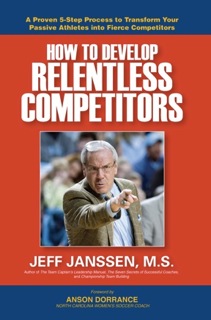
We see it every year in the NCAA Tournament. Multiple underdogs become the big stories early in the tournament. Jeff Janssen is one of the premier sports leadership experts in the country. I have even been fortunate to have contributed to his most recent book Developing Relentless Competitors. Jeff compiled a list of ten strategies for underdogs in any sport for postseason play.

1. "On any given day..." - The belief that "...any team can beat any other team."

2. Nothing to lose mentality - Have fun and play up the fact that the pressure is on the other team.

3. Highlight your successes - Show a film of your season's greatest successes.

4. "The game doesn't know" concept - The game doesn't know who is supposed to win.

5. Find bulletin board material - If your team is in a confident state, find someone who is disrepecting them for motivation.

6. Speak softly, but carry a big stick - Don't give the other team any bulletin board material.

7. Motivational movies - Show them Miracle or Hoosiers.

8. Abraham Lincoln overcoming failure - Remind them of all of the failures "Honest Abe" overcame to succeed as President of the United States (one of my personal favorites).

9. Start strong, manage the momentum, and keep it close - The longer you maintain momentum, the more pressure will fall on the opponent.

10. Motivational themes - Help your team be inspired, confident, focused, and/or loose.

Tuesday, March 13, 2012

NCAA Blog 1: Steve Alford's All-American Workout

The "Xcellence and O's" blog is back and is here to stay. And it's back with a vengeance. What better time to bring it back than the NCAA Tournament? This is the first post of several over the coming weeks where I will profile some basketball knowledge from coaches and/or other key figures involved in this year's NCAA Tournament. I may also add some notes from the Women's NCAA Tournament and some great things from Ohio High School Basketball. Enjoy!


The first post in this series is notes from the very first instructional basketball tape I ever received. It is "Steve Alford's 50-Minute All-American Workout." Yes, Alford was my childhood idol, but this is a great instructional video that is still very consistent with today's game. Alford still uses variations of this workout for his own players at New Mexico. The great thing about this workout is that you do not need a workout partner, thus maximizing your workout time.

3 Keys to Becoming a Great Basketball Player
1) Dedication
2) Discipline
3) Intensity

Decide - "I want to dedicate ________ minutes per day to doing my workout."
You get out what you want to put in.

Workout Routine

- Stretch

- Jump Shot, without dribble (Rebound and spin ball to yourself) - 20/25 shots in 2 minutes

- Shoot 10 FTs (Chart your FTs)

- Jump Shot, with 1-2 dribbles (Cover 3-4 feet on dribble) - 2 minutes

- Shoot 10 FTs

- Backboard Shooting (Shoot mid-range jumpers using backboard, alternating sides) - 2 minutes

- Shoot 10 FTs

- 2-Ball Dribble

- Dribble the Line - Dribble over all lines of the basketball court, cross over when you switch to a new line (Dribble 2 laps right hand, 2 laps left hand)

- Shoot 10 FTs

- Creative Shooting (Have fun and shoot shots you like to shoot) - 2 minutes

- Shoot 10 FTs

- Movement Shooting (Set up a chair at each elbow. Make various moves off of each chair, alternating. Spin ball to yourself as you cut.) - 2 minutes

- Shoot 10 FTs

- Point Moves (Set up a chair with a broom attached. Attack defender with various moves off chair.) - 2 minutes

- Shoot 10 FTs

- Broom and Chair Drill (Get shots while on the move in front of the broom attached to a chair.) - 2 minutes

- Shoot 10 FTs

Monday, May 23, 2011

Daniel Pink's Three Laws of Mastery


I recently finished reading a good book by Daniel Pink called "Drive: The Surprising Truth About What Motivates Us." He mentions three elements that are responsible for motivating us - Autonomy, Mastery, and Purpose. I found his "Three Laws of Mastery" particularly fascinating for anyone wanting to become great at anything.

1. Mastery is a Mindset:
Pink's "Type I" behavior has an incremental theory of intelligence, prizes learning goals over performance goals, and welcomes effort as a way to improve at something that matters.

2. Mastery is a Pain:
"Grit" - perseverance and passion for long-term goals
"Mastery - of sports, music, business - requires effort (difficult, painful, excruciating, all-consuming effort) over a long time (not a week or month, but a decade.)"
"Mastery involves working and working and showing little improvement, perhaps with a few moments of flow pulling you along, then making a little progress, and then working and working on that new, slightly higher plateau again."

3. Mastery is an Asymptote:
"This is the nature of mastery: Mastery is an asymptote. You can approach it. You can home in on it. You can get really, really, really close to it. But...you can never touch it."

Tuesday, May 10, 2011

John Henry Newman on Vocations


I was teaching a class this morning on the topic of vocations. I came across this quote from John Henry Newman about vocations:

“God has created me to do him some definite service: he has committed some work to me which he has not committed to another. I have my mission – I may never know it in this life, but I shall be told it in the next.”

Monday, May 9, 2011

Six Keys to Being Excellent


Tony Schwartz is the President and CEO of The Energy Project and author of "Be Excellent at Anything." He posted his "Six Keys to Being Excellent at Anything."

These keys can serve as an extension of Anders Ericsson's work on "deliberate practice." Ericsson made the case that it takes 10,000 hours of work to achieve expertise.

1. Pursue what you love. - Passion

2. Do the hardest work first. - Delay gratification.

3. Practice intensely, without interruption for short periods of no longer than 90 minutes and then take a break.

4. Seek expert feedback, in intermittent doses.

5. Take regular renewal breaks. - Relax after intense effort.

6. Ritualize practice. - Build specific, inviolable times at which you do them, so that over time you do them without having to squander energy thinking about them.

You can find more from Tony Schwartz on his website http://tonyschwartz.com/